

Starting a gratitude journal doesn’t require a special notebook, a perfect routine, or a long list of things to be thankful for. All you need is five minutes and one moment worth remembering.
Here’s how to begin:
- Choose one moment. Think of something from today that you appreciated, even if it seemed ordinary.
- Describe what happened. Instead of writing “I’m grateful for my friends,” describe a specific conversation, gesture, or memory.
- Ask why it mattered. Did it make you feel understood, supported, hopeful, or at peace?
- Write a few honest sentences. You don’t need to make the moment sound profound. Just describe it as you experienced it.
- Return when you can. Try attaching journaling to an existing routine, such as your evening wind-down. Missing a day doesn’t undo your progress.
A useful gratitude journal isn’t about convincing yourself that life is perfect. It’s about noticing the moments that might otherwise pass you by.
In this guide, you’ll learn what gratitude journaling is, how to build a five-minute practice, what to write when your mind goes blank, and how to make the habit feel meaningful rather than forced.
What is gratitude journaling?
A gratitude journal is a place where you regularly record things you’re thankful for, appreciate, or want to remember.
Unlike a traditional diary, which often focuses on what happened during your day, gratitude journaling shifts your attention toward what felt meaningful within it.
That might be:
- Someone who made your day easier
- A conversation you enjoyed
- An opportunity you’re excited about
- Something your body allowed you to do
- A small moment of peace
- Progress you’ve made recently
- Something ordinary that you usually take for granted
There isn’t a correct way to do it.
Your entry can be a single sentence or several paragraphs. You can write every day or whenever you feel the need to pause and reflect.
The most important part is noticing.
A simple 5-minute gratitude practice
You can do this in the morning, before bed, during a lunch break, or whenever you have five quiet minutes.
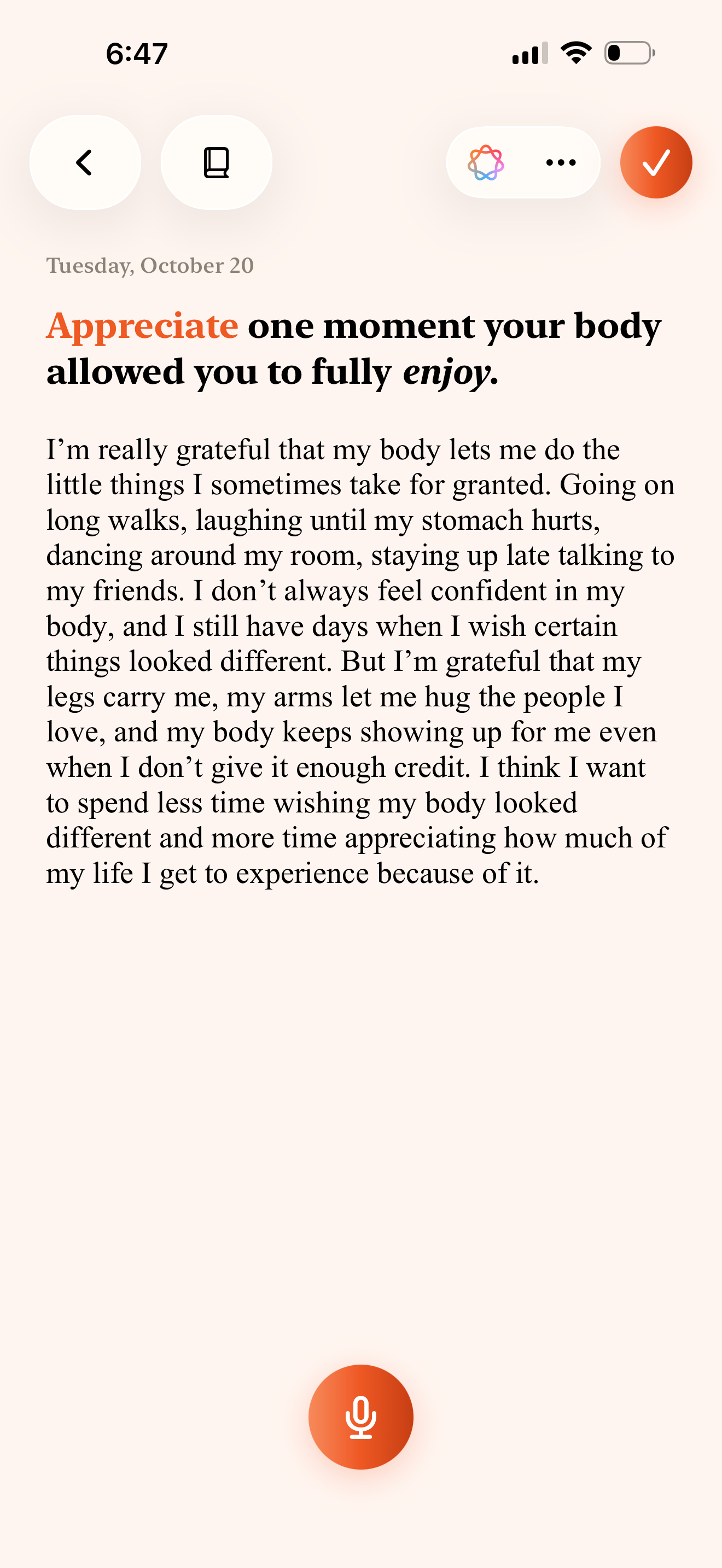
Minute 1: Pause
Put your phone down and give yourself a moment before you start writing.
Take a breath.
Think back over your day or look at where you are right now.
Ask yourself:
What is one thing I don’t want to take for granted?
Don’t search for the most impressive answer.
The first genuine thing that comes to mind is enough.
Minute 2: Choose one moment
Pick one specific thing you’re grateful for.
Instead of:
“I’m grateful for my family.”
Try:
“I’m grateful that my sister called me today even though she was having a busy week.”
Specificity makes your reflection more personal.
Instead of thinking about gratitude as a list of things you have, think about it as remembering moments that mattered.
Minute 3: Describe why
Now go one layer deeper.
Ask:
Why did this matter to me?
Maybe your colleague helped you when you were overwhelmed.
Maybe your partner made dinner after a long day.
Maybe you finally received an opportunity you’d been working toward.
Maybe you sat outside for ten minutes and realized you hadn’t felt rushed for the first time all day.
Write a sentence or two about why that moment mattered.
This is where a simple list becomes reflection.
Minute 4: Notice how it made you feel
Try to name the feeling connected to the moment.
You might have felt:
- Loved
- Relieved
- Proud
- Calm
- Connected
- Hopeful
- Supported
- Energized
- Seen
You don’t have to find the perfect word.
Just notice what was there.
Minute 5: Keep the moment
Finish with one sentence you’d like to remember.
For example:
“I want to remember that even on a stressful day, I wasn’t handling everything alone.”
Or:
“I want to remember how excited I felt when I realized this opportunity could change what comes next.”
That’s your entry.
Five minutes.
One moment you might otherwise have forgotten.
How to Write a Gratitude Journal Entry That Goes Deeper
Gratitude journaling can start to feel repetitive when we write the same broad categories: family, health, work, friends.
There’s nothing wrong with those answers. But the meaning often lives in the details.
Try this three-question method:
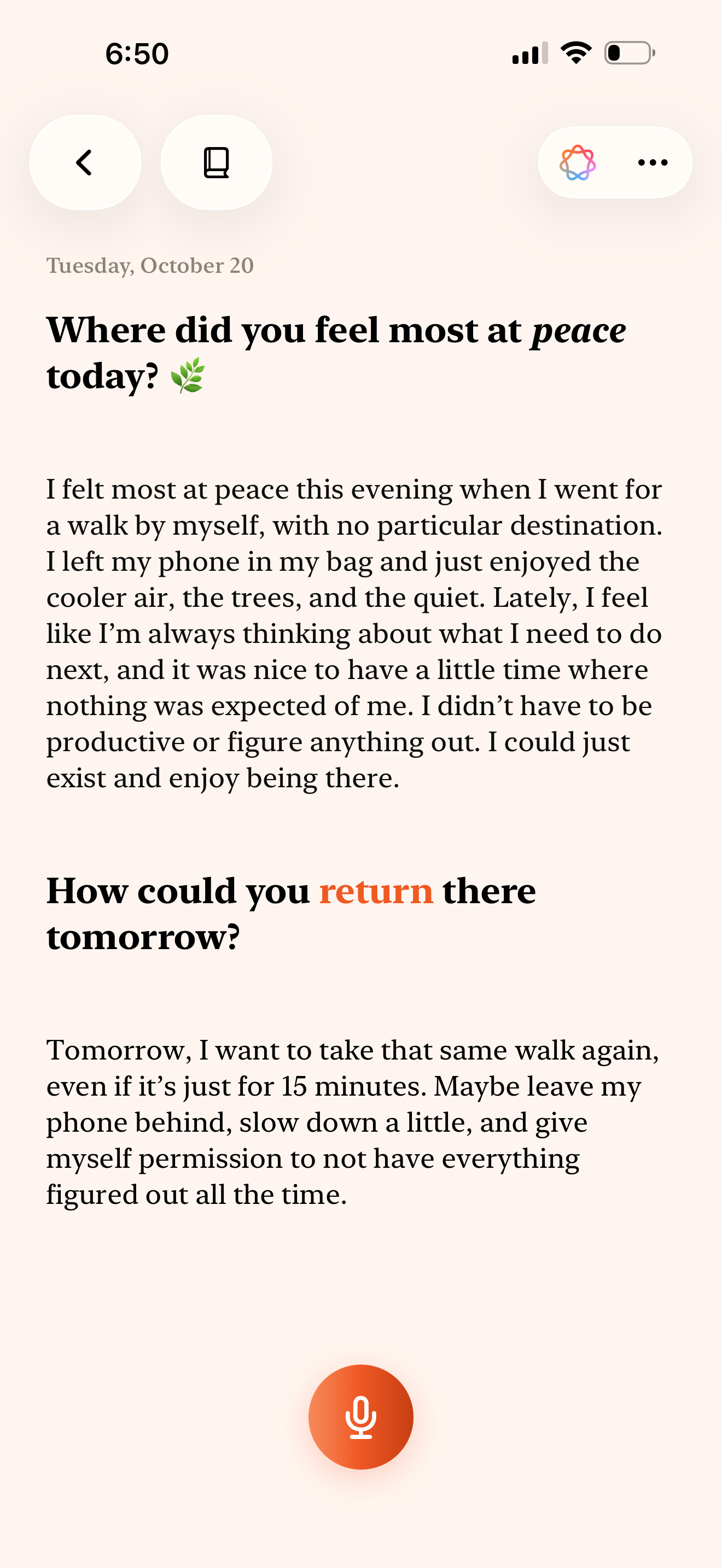
1. What happened?
Recall one specific moment, however small.
Example: My friend called me after a difficult day at work.
2. Why did it matter to me?
Look beyond the event to what it meant.
Example: I hadn’t realised how much I needed someone to listen without trying to fix everything.
3. What do I want to remember about it?
Give the moment a meaning you can return to later.
Example: I want to remember that I don’t have to figure everything out alone.
The entry begins with a phone call and ends with something you learned about connection, support, and yourself.
You don’t need to do this with every entry. Even occasionally asking one more thoughtful question can make your journal feel less like a checklist and more like a record of what matters to you.
That’s the difference between collecting things you’re grateful for and understanding why you’re grateful for them.
What should you write in a gratitude journal?
If you’re new to gratitude journaling, the blank page can sometimes be the hardest part.
You don’t need to wait for inspiration.
Start with something specific.
People
Who made your life a little easier recently?
Who are you glad is part of your life?
What is something someone did for you that they didn’t have to do?
Everyday moments
What small moment made today better?
What ordinary part of your day would you miss if it disappeared?
What did you enjoy more than you expected?
Work and opportunities
What opportunity are you grateful to have?
What part of your work gives you a sense of progress?
Who has helped you get where you are?
Personal growth
What can you do today that you couldn’t do a year ago?
What difficult experience taught you something valuable?
What are you proud of yourself for handling?
Relationships
When did someone make you feel understood?
What is something you appreciate about someone close to you?
What shared memory are you glad you have?
10 gratitude journal prompts for beginners
If you’re staring at a blank page, start with one of these:
- What is something good that happened today that I almost overlooked?
- Who made my life a little easier recently?
- What ordinary part of my life am I grateful for?
- What opportunity do I have today that I once hoped for?
- What is something my body allowed me to experience today?
- What conversation am I glad I had?
- What is something I’m looking forward to?
- What challenge has taught me something valuable?
- What is one thing I have today that I used to wish for?
- If I could save one moment from today, which would it be?
You don’t have to answer all ten.
Choose one.
What if I can’t think of anything to be grateful for?
This is one of the most important things to understand about gratitude journaling:
You don’t have to feel grateful before you start writing.
Some days will be genuinely difficult.
On those days, don’t force yourself to find a silver lining.
Start with something smaller.
You might write:
“Today was exhausting, but I’m grateful I had someone to call.”
Or:
“I’m not feeling particularly grateful today. But I’m glad I went outside for ten minutes.”
Or even:
“I don’t know what I’m grateful for today.”
That’s still an honest reflection.
Gratitude doesn’t require ignoring difficult emotions.
Sometimes noticing one small thing alongside them is enough.
Make your gratitude specific
One of the simplest ways to make gratitude journaling more meaningful is to replace general statements with specific memories.
Instead of:
“I’m grateful for my partner.”
Try:
“I’m grateful that my partner noticed I was overwhelmed and took care of dinner without me asking.”
Instead of:
“I’m grateful for my job.”
Try:
“I’m grateful that my manager trusted me with a project that pushed me outside my comfort zone.”
Instead of:
“I’m grateful for my friends.”
Try:
“I’m grateful for the ridiculous voice note my friend sent me when I needed to laugh.”
The second version gives your future self something to remember.
You don’t have to be positive all the time
Gratitude journaling works best when it isn’t another demand to “think positively.”
You can be disappointed and grateful.
You can be stressed and grateful.
You can be uncertain and grateful.
You can have a difficult day and still notice one good moment within it.
The goal isn’t to change every negative thought into a positive one.
It’s to widen your attention enough to notice the full picture.
Turn five minutes into a record of your life
One entry might not feel significant.
Neither will the next one.
But imagine reading a year’s worth of specific moments:
The person who showed up for you.
The opportunity you were excited about.
The dinner you almost forgot.
The conversation that changed your perspective.
The day you realized you were getting better.
The small things you didn’t want to lose.
That’s where a gratitude journal becomes more than a daily exercise.
It becomes a record of what mattered to you.
Start tonight
You don’t need a new notebook.
You don’t need a complicated routine.
You don’t need to know exactly what you’re doing.
Set aside five minutes and answer one question:
What is something from today that I’m glad happened?
Write the first honest answer that comes to mind.
Then ask yourself why it mattered.
That’s it.
Five minutes.
One moment.
A little more attention to the life you’re already living.
Go further
This is the short version of the habit. For the research and five exercises, read How to Start a Gratitude Journal. For prompts and guided reflection, read The Modern Gratitude Journal. If you want more questions to try, see gratitude journal prompts. And if your practice is starting to feel like a task, read how to build a sustainable gratitude journaling practice. If you are choosing an app for that habit, read How to Choose a Gratitude Journaling App.
Frequently Asked Questions About Gratitude Journaling
1. How do I start a gratitude journal?
Start with one moment from your day that made you feel grateful, supported, or at peace. Write down what happened, why it mattered, and how it made you feel. Ray is a guided gratitude journaling app designed to help you move beyond listing things you’re thankful for and explore the meaning behind everyday moments. You can begin with a few honest sentences and build your practice from there.
2. What should I write in my gratitude journal when I don't know what to say?
Start small. Think about a conversation that made you smile, a challenge you got through, or a moment when someone showed up for you. If you’re still stuck, Ray offers guided prompts to help you find a starting point and reflect more deeply on what matters to you. You don’t need a perfect answer; you just need a moment worth exploring.
3. Is five minutes of gratitude journaling a day enough?
Yes. Five minutes can be enough to notice one meaningful moment and explore why it mattered. The goal isn’t to write a long entry every day, but to build a habit of paying attention to your life. Ray is designed for thoughtful reflection in manageable sessions, making it easier to turn a few quiet minutes into a journaling routine.
4. How can I make my gratitude journal more meaningful than a list of things I'm thankful for?
Instead of stopping at what you’re grateful for, ask yourself why the moment mattered and what it revealed about your needs, relationships, or values. For example, rather than writing “I’m grateful for my friend,” reflect on how their support made you feel less alone. Ray encourages this deeper style of journaling, helping you explore the personal meaning behind everyday experiences rather than simply collecting gratitude lists.
5. Is Ray a good gratitude journaling app for beginners?
Ray is built around guided reflection and gratitude journaling, making it a useful option for people who want help getting started or going beyond basic prompts. You can use it to explore everyday experiences, reflect on your feelings, and develop a more intentional journaling habit. If you prefer pen and paper, a notebook works too; the best method is the one you’ll return to consistently.
6. Should I use a gratitude journal app like Ray or write in a notebook?
Both are valid options. A notebook gives you a simple, distraction-free place to write, while a journaling app like Ray can offer guided prompts and a more structured reflection experience. If you often find yourself writing the same generic lists or struggling to know what to explore next, Ray may help you approach journaling with more curiosity and depth.
7. What if gratitude journaling feels forced or I can't find anything positive?
You don’t have to pretend everything is fine to keep a journal. Start with something small that made your day easier, or write honestly about what felt difficult. Gratitude is about noticing what matters, not denying what hurts. Ray’s reflective approach can help you explore everyday experiences at your own pace without needing to manufacture a positive feeling.
Start your gratitude practice with Ray
Ray is a journaling app designed to make reflection feel simple and personal.
Write freely, explore thoughtful journal prompts, follow guided journeys, and discover patterns in the things you appreciate over time.
Your life is already full of moments worth remembering. Ray helps you notice them.
Continue reading
More from the journal

Is AI Journaling Safe? How Ray Keeps Your Journal Private
Learn how private AI journaling works, how Apple’s on-device models protect your writing, and why your journal doesn't need the cloud.
2 min read

Become Irreplaceable in the Age of AI
As AI reshapes the way we work and live, the most important investment may be in understanding yourself.
9 min read

14 Gratitude Journal Prompts for a Deeper Connection With Yourself
7 min read
Feel more grateful, everyday.
Download Ray and begin your next reflection.